 d7396073ee
|
||
|---|---|---|
| .github/workflows | ||
| config | ||
| img | ||
| sample_files | ||
| src | ||
| .gitignore | ||
| Cargo.lock | ||
| Cargo.toml | ||
| README.md | ||
| after.js | ||
| before.js | ||
| text_diff_notes.md | ||
README.md
It's Difftastic!
Difftastic is an experimental structured diff tool that compares files based on their syntax.
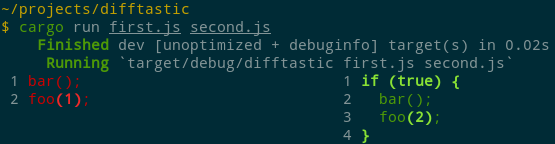
It is very much unfinished. It works reasonably on very parenthesised data (lisps, JSON), it works sometimes on other languages with sufficient parentheses (Rust, JS), and falls back to a line-oriented diff otherwise.
See config/syntax.toml to see how languages are defined.
Other Diff Techniques
There are a bunch of other ways of diffing text files. I summarise them here, along with example invocations.
Myers' diff algorithm
This is the default diff algorithm in GNU diff and git diff. It finds the longest common subsequence (LCS) and is used on a line-by-line basis.
There's a great introduction here and the original paper is An O(ND) Difference Algorithm and Its Variations, Myers 1986.
# Modern diff supports colour, but see also
# https://www.colordiff.org/
$ diff --color=always -u sample_files/css_before.css sample_files/css_after.css
Note that GNU diff originally used the Hunt-McIlroy algorithm).
Patience Diff
Myer's diff has a problem with sliders:
 if (!$smtp_server) {
+       $smtp_server = $repo->config('sendemail.smtpserver');
+}
+if (!$smtp_server) {
        foreach (qw( /usr/sbin/sendmail /usr/lib/sendmail )) {
                if (-x $_) {
                        $smtp_server = $_;
Instead of:
+if (!$smtp_server) {
+       $smtp_server = $repo->config('sendemail.smtpserver');
+}
 if (!$smtp_server) {
        foreach (qw( /usr/sbin/sendmail /usr/lib/sendmail )) {
                if (-x $_) {
Git has a --indent-heuristic that was added to reduce the
likelihood of making a bad
choice. There's
a corpus of test files
where the ideal diff has been chosen by a human, to test different
heuristics.
The patience diff algorithm is an LCS algorithm that aims to do a better job with sliders. It produces great results by doing more work.
# Original behaviour
$ git diff --no-indent-heuristic --no-index sample_files/css_before.css sample_files/css_after.css
# As of git 2.11, this heuristic is enabled by default.
$ git diff --indent-heuristic --no-index sample_files/css_before.css sample_files/css_after.css
# Patience algorithm does a better a job in this example.
$ git diff --patience --no-index sample_files/css_before.css sample_files/css_after.css
Diff Match Patch also has some excellent discussions of diff designs on the author's website (e.g diff strategies).
Histogram Diff
Git 1.7.7+ also has a histogram algorithm, which aims to produce better results than Myers' algorithm but without the slowdown of the patience algorithm.
# Inferior to patience on this example file.
$ git diff --histogram --no-index sample_files/css_before.css sample_files/css_after.css
Side-by-side Diff
$ diff -y --color=always sample_files/css_before.css sample_files/css_after.css
Tree Diff
Most tree diff implementations focus on XML, and there's a great overview of techniques in this blog post.
Jane Street's patdiff implements a tree diff, using an A* algorithm.
prettydiff
prettydiff does really well out of the box with the sample files here. It implements LCS on words.
wu-diff
wu-diff doesn't have much documentation, but it gives the same results as other LCS implementations in Rust.
JSON diff
json-diff provides a proper structural diff for JSON files.
graphtage
graphtage compares structured data by parsing into a generic file format, then displaying a diff. It finds the optimal edit sequence, and even allows things like diffing JSON against YAML.