 8b382e4356
Fixes #17 Fixes #15 |
||
|---|---|---|
| .github/workflows | ||
| config | ||
| img | ||
| sample_files | ||
| src | ||
| .gitignore | ||
| CHANGELOG.md | ||
| Cargo.lock | ||
| Cargo.toml | ||
| LICENSE | ||
| README.md | ||
| text_diff_notes.md | ||
README.md
It's Difftastic!
Difftastic is an experimental structured diff tool that compares files based on their syntax.
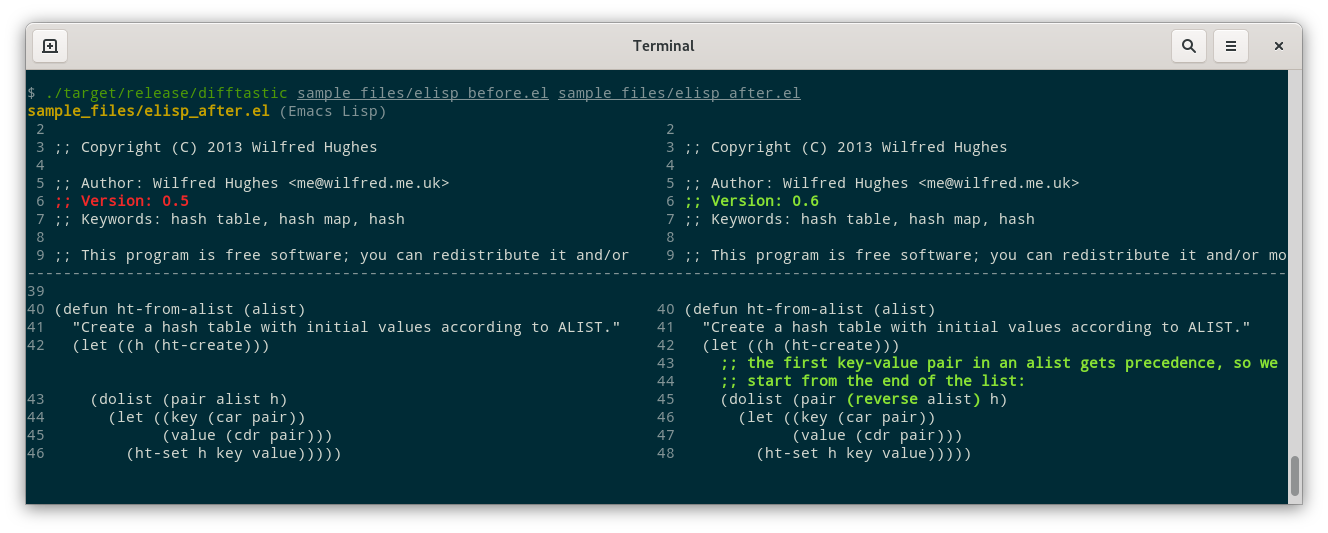
It is very much unfinished. It works reasonably on very parenthesised data (lisps, JSON), it works sometimes on other languages with sufficient parentheses (Rust, JS), and falls back to a line-oriented diff otherwise.
How It Works
(1) Parsing.
Difftastic treats source code as a sequence of atoms or (possibly nested) lists.
Language syntax is defined in config/syntax.toml: you provide
regular expressions for atoms (including comments), open delimiters,
and close delimiters.
This is heavily inspired by Comby, which handles a large number of languages by using a similar approach.
(2) Diffing.
Difftastic treats diff calculations as a graph search problem. It finds the minimal diff using Dijkstra's algorithm.
This is based on the excellent Autochrome project.
(3) Printing.
Difftastic prints a side-by-side diff that fits the current terminal. It will try to align unchanged nodes (see screenshot above).
Known Problems
Crashes. The code is underdocumented, undertested, and unfinished.
Performance. Difftastic scales relatively poorly on files with a large number of changes, and can use a lot of memory. This might be solved by A* search.
Replacing top-level expressions. If you delete a function and write a completely different new one, difftastic will show the small number of common tokens between them.
Comments. Small changes can show big diffs.
Non-goals
Patch files. If you want to create a patch that you can later apply,
use diff. Difftastic ignores whitespace, so it is output is
lossy. (AST patching is also a hard problem.)
Testing with Git
[diff]
        tool = difftastic

[difftool "difftastic"]
        cmd = ~/projects/difftastic/target/debug/difftastic "$LOCAL" "$REMOTE"
You can then run git difftool -y to see the current repo changes in
difftastic.
Further Reading
The wiki includes a thorough overview of alternative diffing techniques and tools.